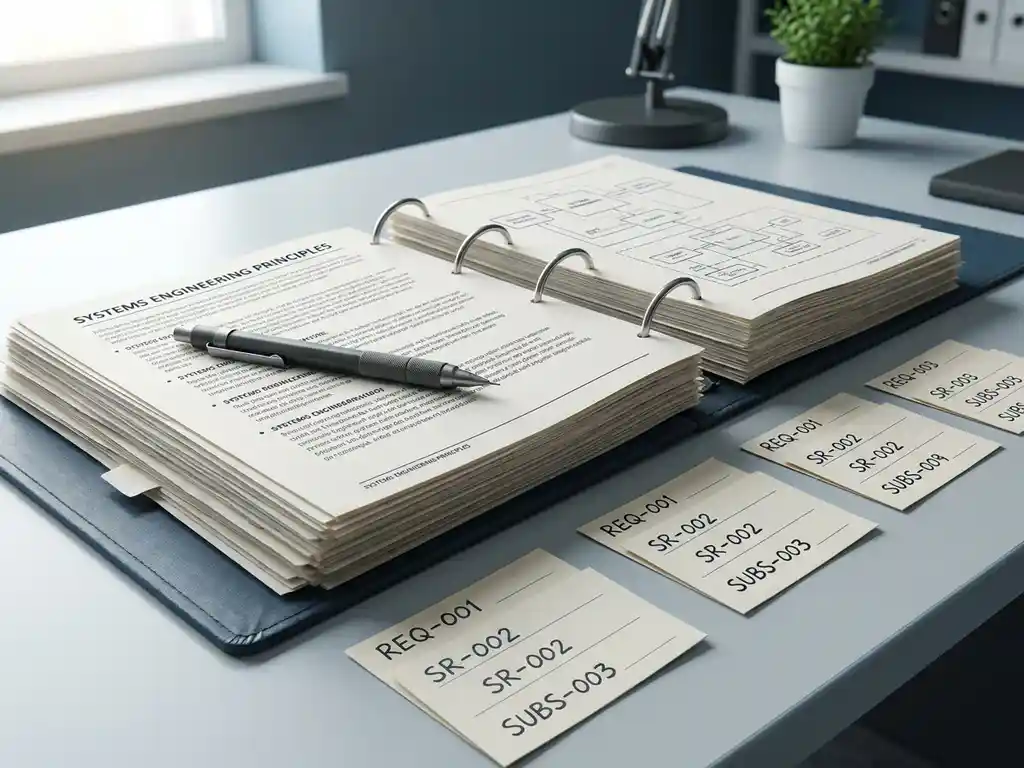
A systems engineering plan and requirements management are inextricably linked: the SE plan determines how requirements management is set up, executed, and assured throughout the entire project lifecycle. Without this connection, requirements remain isolated documents without structure or ownership. The sections below answer the most frequently asked questions about this relationship and provide concrete guidance for making both work together.
A systems engineering plan typically includes a section on requirements management. This section outlines the processes, tools, and responsibilities for defining, documenting, analyzing, tracking, and controlling requirements throughout the system's lifecycle. It covers aspects such as: * **Requirements Definition:** How requirements will be elicited, analyzed, and documented. * **Requirements Documentation:** Standards and formats for writing requirements (e.g., SRS - Software Requirements Specification). * **Requirements Traceability:** The ability to track requirements from their origin to their implementation and verification. * **Requirements Baseline:** Establishing a stable set of approved requirements. * **Requirements Change Management:** The process for submitting, evaluating, approving, and implementing changes to requirements. * **Requirements Verification and Validation (V&V):** How requirements will be verified to ensure they are correctly implemented and validated to ensure they meet user needs and objectives. * **Tools and Metrics:** The software tools and key performance indicators (KPIs) that will be used to support requirements management. * **Roles and Responsibilities:** Who is responsible for each aspect of requirements management. * **Reporting:** How the status of requirements will be reported.
A systems engineering plan describes how requirements management is organized as a process within a project. It specifies who is responsible for the creation, review, and approval of requirements, which categories of requirements are distinguished, how changes are managed, and which tools or methods are used. Requirements management is therefore a core component of any SE plan.
Concretely, the SE plan for requirements management typically includes the following elements:
- Iron decomposition How are stakeholder requirements translated into system and subsystem requirements
- Ownership and Roles: Who is responsible for which requirements set
- Change Management The process for requesting, reviewing, and implementing change requirements.
- Verification and validation strategy: How is compliance with requirements demonstrated?
- Tooling and storage: where requirements are documented and how traceability is ensured
An SE plan without an explicit description of requirements management is incomplete. The quality of your requirements set hinges on the agreements you establish in advance about how you will handle it.
How does the SE plan influence the structure of your requirements set?
The systems engineering plan directly determines the structure of your requirements set by specifying the decomposition hierarchy, naming, and categorization of requirements. If the SE plan works with a three-level functional decomposition, then the requirements set will exactly mirror that structure. The plan thus serves as the architectural framework upon which the requirements set is built.
In practice, this means that choices in the SE plan have direct consequences for how requirements are grouped and managed. If the plan opts for an object-based approach, requirements are linked to specific system objects. If the plan opts for a functional classification, requirements follow the function tree. This choice also determines how easy it will be to find, modify, or transfer requirements later.
A common mistake is that the requirements set grows organically without using the SE plan as a guide. The result is an unstructured collection of requirements that no one can oversee anymore. By consistently deriving the structure of your requirements set from the SE plan, you prevent this and maintain the coherence between system design and requirements management.
What is traceability and why is it inextricably linked to the SE plan?
Traceability is the ability to trace each requirement back to its origin and forward to its design, verification, and proof of realization. It is inextricably linked to the systems engineering plan because the SE plan establishes the rules for how those links are made, tracked, and controlled. Without those rules, traceability exists only on paper.
A good traceability structure makes it possible to answer questions like the following directly:
- Which stakeholder journey underlies this system requirement?
- Which design element fulfills this requirement?
- Which test procedure demonstrates that the requirement has been met?
- What is the impact if this requirement changes?
The SE plan describes how these links are recorded and who is responsible for them. During audits or project transfers, traceability is not a luxury but a requirement. If these links are manually maintained in separate files, the chance of errors and gaps is high. A structured approach, anchored in the SE plan, is the only way to keep traceability reliable throughout the entire project lifecycle.
How do you keep requirements management and the SE plan consistent during project changes?
Consistency between the SE plan and the requirements set during project changes is achieved through a formal change management process that treats both documents as a single entity. Every change in scope, system definition, or project approach must be assessed for its impact on the requirements set, and vice versa. Those who do not guarantee this process will inevitably end up with a requirements set that no longer aligns with the current SE plan.
In practice, this means:
- Impact analysis with every change: Always ask which requirements are affected by a change to the system or project approach.
- Version control for both documents: Ensure that the SE plan and the requirements set have the same version history and are linked to each other.
- Formal review moments: plan periodic reviews where the SE plan and requirements set are assessed together for consistency
- Clear ownership: Assign responsibility for consistency explicitly to a person or role
Project changes are inevitable. The organizations that handle them best are those that have structurally aligned the link between SE plans and requirements management, and are not dependent on individual knowledge or good intentions.
Which tools support the integration of SE P and requirements management?
Tools that support the integration of a systems engineering plan and requirements management offer at least the ability to structure requirements, capture traceability, generate verification matrices, and track changes in one central environment. Well-known options range from heavy MBSE platforms to more accessible alternatives that better suit smaller teams or more limited budgets.
Traditional MBSE tools
Tools such as IBM DOORS and Cameo Systems Modeler offer comprehensive functionality for requirements management and systems modeling. They are powerful, but also expensive and complex to implement. For many teams in the Dutch infrastructure, water, and manufacturing industries, they are therefore not a viable option in practice.
Accessible Alternatives
Wij ontwikkelden Datastorms als een no-code informatieplatform dat systems engineers grip geeft op de volledige complexiteit van hun projecten, van eisendecompositie en traceability tot verificatiematrices en formele overdracht, zonder de drempel van dure of complexe tooling. Het platform past zich aan op de specifieke structuur van jouw SE plan en sluit via een uitgebreide API aan op tools die al in gebruik zijn. Zo wordt de integratie tussen SE plan en eisenbeheer niet alleen beschreven, maar ook daadwerkelijk ondersteund in de dagelijkse praktijk. Wil je zelf ervaren hoe dit werkt in jouw projectomgeving? Vraag een proeflicentie aan en ontdek wat het platform voor jouw team kan betekenen.
The choice of a tool depends on the scale of your project, the budget, and the complexity of your requirements. What always applies: a tool is not a substitute for a well-established process. The agreements in the SE plan remain leading; the tool makes them executable.
Frequently Asked Questions
How do I start creating a Systems Engineering plan if there is no requirements set yet?
Start by mapping your stakeholders and their needs before you formulate any requirements at all. The SE plan will then first describe the process: who provides input, how stakeholder wishes are translated into requirements, and what structure you use for this. By defining the process in advance, you prevent the requirements set from being built on shaky ground later. A simple two-level requirements decomposition is a solid starting point for smaller projects.
What are the most common mistakes in linking an SE plan to requirements management?
The most common mistake is that the SE plan is created once at the project start and then no longer maintained, while the requirements set *does* evolve. A second common problem is the lack of clear ownership: if no one is explicitly responsible for the coherence between the two, they will inevitably drift apart. Finally, teams underestimate how quickly a requirements set becomes unmanageable if traceability is not structurally maintained from the outset.
How detailed should the SE plan be in its description of requirements management?
Het SE plan hoeft geen handboek te zijn, maar moet wél concreet genoeg zijn om als dagelijkse leidraad te dienen. Beschrijf minimaal: de structuur van de eisenhiërarchie, de rollen en verantwoordelijkheden, het wijzigingsbeheerproces en de verificatiestrategie. Hoe complexer het project en hoe groter het team, hoe meer detail nodig is om misverstanden en afwijkend handelen te voorkomen. Een SE plan van twee pagina’s dat iedereen kent en gebruikt, is meer waard dan een uitgebreid document dat in de la blijft.
Can I set up requirements management without a formal SE plan if the project is small?
Technisch gezien wel, maar ook bij kleine projecten loont het om minimaal de kernafspraken over eisenbeheer schriftelijk vast te leggen. Denk aan: wie is eigenaar van de eisen, hoe worden wijzigingen goedgekeurd, en hoe toon je achteraf aan dat aan eisen is voldaan. Zonder die afspraken ontstaan discussies op het moment dat het er écht toe doet, zoals bij oplevering of bij een geschil met een opdrachtgever. Een lichtgewicht SE plan van een paar pagina’s is voor elk project haalbaar en de moeite waard.
How do I actively involve stakeholders in the requirements management process as described in the SE plan?
Explicitly define in the SE plan at which points stakeholders will be involved, such as during the elaboration of stakeholder requirements, formal reviews, and impact analyses of changes. Provide stakeholders insight into the requirements set through a tool or reporting that aligns with their knowledge level, avoiding technical jargon. By structuring involvement through fixed review moments and clear roles, you prevent both overload and the risk of crucial input surfacing late in the project.
How do I deal with conflicting requirements that are discovered late in the project?
Conflicting requirements that are discovered late are almost always the result of poor traceability or the absence of formal review points early in the project. Resolve the conflict through the change management process as described in the SE plan: analyze the impact, involve the appropriate stakeholders, and document the decision including the rationale. Also, use the incident as an opportunity to improve the traceability structure, so that similar conflicts are identified earlier in the future.
What is the difference between verification and validation in the context of requirements management, and how does the SE plan capture this?
Verificatie beantwoordt de vraag ‘bouwen we het systeem zoals gespecificeerd?’, terwijl validatie beantwoordt ‘bouwen we het juiste systeem voor de stakeholder?’. In de context van eisenbeheer betekent dit dat verificatie toetst of aan de geformuleerde eisen is voldaan, en validatie toetst of die eisen de werkelijke behoefte correct weerspiegelen. Het SE plan legt voor beide vast welke methoden worden gebruikt, wie verantwoordelijk is en op welke momenten in de projectlevenscyclus ze worden uitgevoerd.
Related Articles
- Hoe gebruik je MBSE bij de overdracht van ontwerp naar beheer?
- Wat zijn de grootste struikelblokken bij de invoering van MBSE?
- Wat is model based systems engineering?
- Waarom is het beheren van eisenwijzigingen zo tijdrovend zonder goed systeem?
- Hoe gebruik je MBSE om eisen visueel inzichtelijk te maken voor stakeholders?