
Library development is on the rise. In the theory of complex systems engineering, the term ObjectType Library (OTL) is used. An ObjectType Library (OTL) is a structured collection of object types used within a particular domain or application. Each object type within the library defines the properties, relationships and behavior of a particular type of object in a standardized form. A further extension to this basic definition is the addition of requirements and verifications to each object. These libraries are often used to create consistency and promote collaboration.
A solidly built organization is necessary to properly manage and deploy an OTL. The deployment of tooling is one of the aspects critical to success. Tooling ensures that the whole becomes and remains manageable. In addition to technical and content knowledge surrounding the structure of the OTL, it is essential to clearly define roles and responsibilities. Tooling plays an important role in making this manageable and facilitating the process. In our Datastorms application, we have developed building blocks for this purpose.
Datastorms is the only high-end semantic Graph platform that offers this structure integrated and model-based.
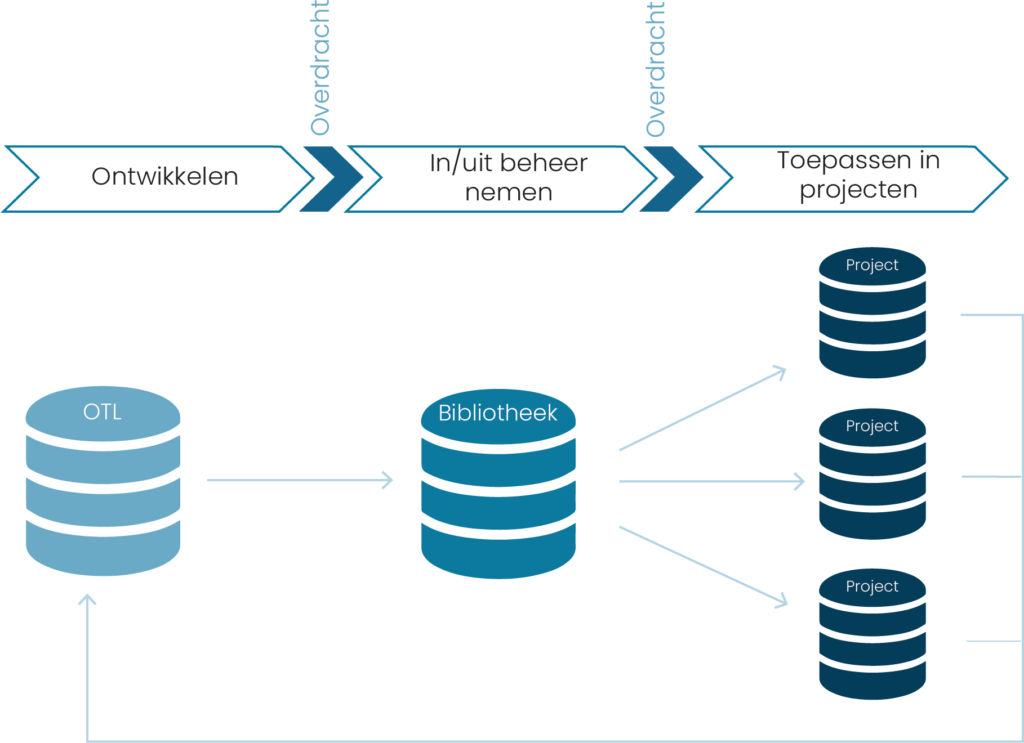
How do our Datastorms building blocks help to structurally move from an object-oriented OTL (without requirements) to an object + requirement-oriented OTL?
OTL
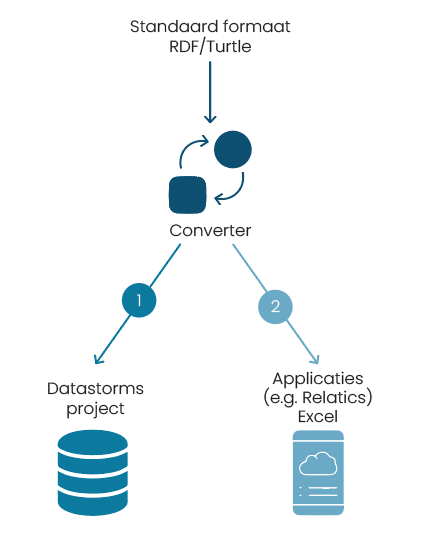
We encounter situations where the OTL is already built in an application such as TopTeam or Laces. How can you then take the next step toward a requirements library or directly to a project? With the advanced Datastorms API building block or Datastorms' RDF/Turtle converter, this can be easily accomplished. After this first step, you can choose to export this practical data, whose complex structure does remain, to another application (2) or use it as input for the next step: the library or project (1).
Library
The Connector-building block allows the library to communicate real-time with one or more projects. What data is offered real-time to the projects or fed into them is configurable.
The Workflow-function automates work processes ranging from automatically changing statuses to sending emails requesting review of a proposed change.
Analyzing various baselines and assessing the impact of changes on ongoing projects is all visible in both the library and projects. Our report- and dashboard-building blocks are enormously functional in this regard.
Additions can also be made to the OTL in this library. Consider specifically adding objects and requirements relevant to the context of your own organization.
Project
Once the foundation of the data and OTL definition, or a complete library, is in place, the fruits of the extra effort can be reaped in one or more projects (as this is often experienced). The projects only need to be built once and can then be updated as a template, template for all projects associated with this template.
What are some of the benefits of working with a library? We list a few examples that we have seen in practice:
1. A project can start quickly based on the knowledge that can be taken over from the library. Because this knowledge is already integrally correct, this allows the project to get off to a flying start. This requires less capacity from the Technical Manager involved to figure out what data he is now being supplied with.
2. Based on the OTL, the project can continue to develop independently and add project-specific requirements.
3. Because the project starts from the same structure as the library, namely the OTL, the basis for the Learning Organization is laid immediately. Changes to the library, changes in the project, they are immediately visible. In addition, improvements can be delivered from the projects back to the library through this structure.
4. Contract formation toward Contractors is consistent across projects because all use the same OTL as a basis. This produces more predictable contracts, resulting in fewer questions and more competitive bids.
5. Data exchange with Contractors is easier to coordinate: every project works the same way with the same structure.
6. Innovations are easier to integrate because the clear structure makes it quicker to check whether they fit within the frameworks established in the OTL. Once the innovation has a place in the library, it is immediately available to all projects.
7. When the requirements are also linked to the properties of the Object Types, then it is also possible to really start automating. The data is then not only readable by humans, but also computers can then understand it. This means that valuable time of technical people can go to the creative challenges, and the time-consuming tasks can be performed by the computer.
Of course, this list can be expanded even further. By default, the GIS building block can be used. It can also be linked to document management systems (Sharepoint) to have the evidence documents linked to verifications, for example.
Once a basic library with OTL is in place, links to other Libraries (environment, risk and licensing) can also be considered.
The main Infra Systems Engineering processes are already worked out in the standard template that Datastorms has developed based on 20+ years of experience with these processes. Please refer to our project Infra SE template.
Are you interested in implementing the above innovation in your organization as well? Please visit contact with our experts to discuss options.