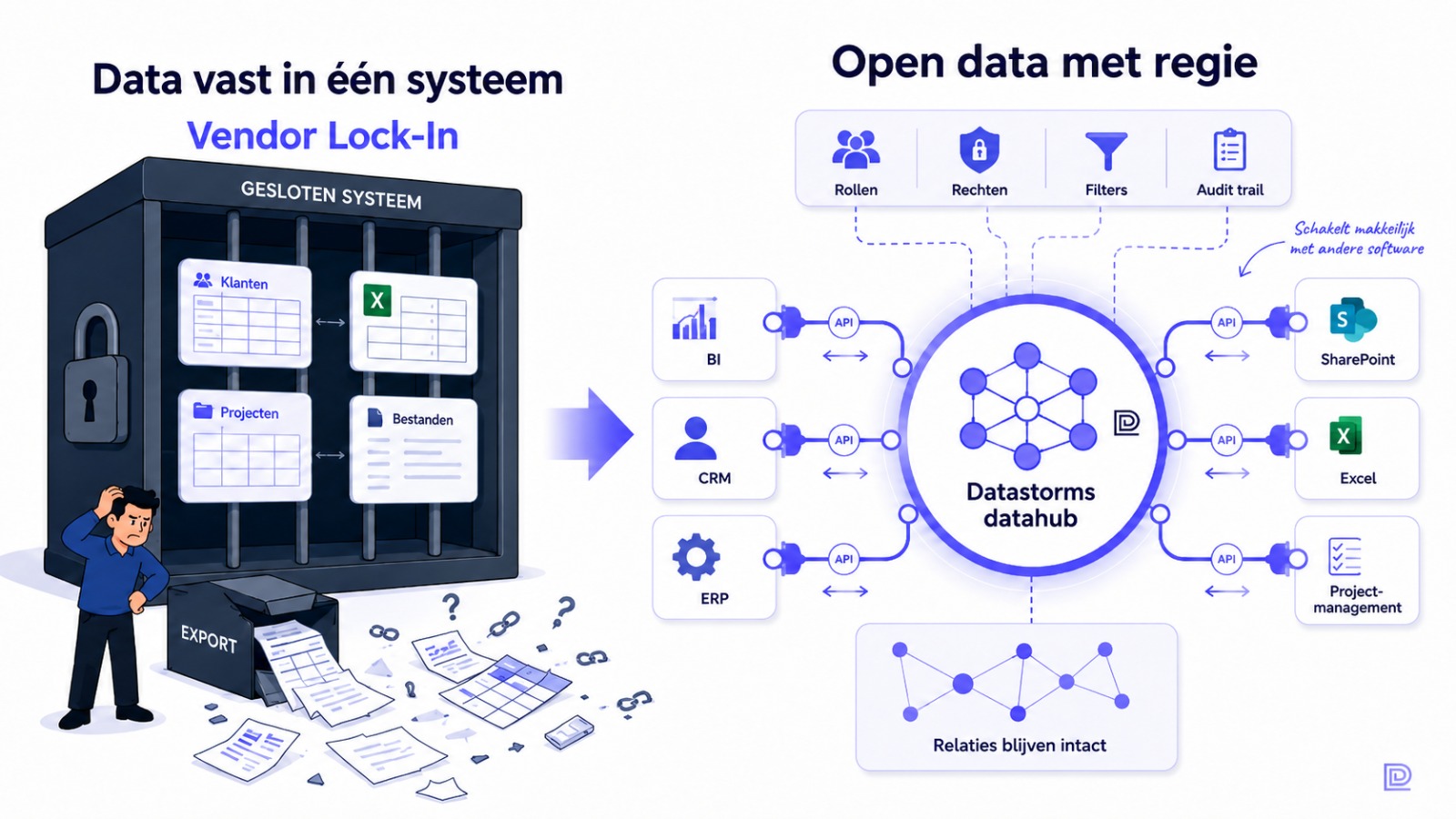
Anyone working in information management will quickly come to the same ambition: preventing vendor lock-in. It's almost becoming a buzzword. But what's the reality of it?
From the energy sector to the maritime sector: organizations are investing in Knowledge Graphs, Object Type Libraries (OTLs), and data standards to better structure information and enable systems to collaborate.
Yet vendor lock-in is not as black and white as often thought. It's not just about whether data is accessible or not. The relevant question is: can you take information, including meaning, relationships, and rights, to another environment in a controlled manner? Let's dive deeper into this. At the end of the text, we'll conclude with an FAQ.
When does vendor lock-in actually occur in practice?
Vendor lock-in occurs when data, processes, and a data model are so tightly coupled to a single application that switching becomes complicated. On paper, the information is often owned by the organization. The challenge begins as soon as that information needs to be exported.
An export, for example, could consist of individual tables, technical files, or fields without any mutual relationship. It is precisely this relationship that makes information usable: what information it contains and how it is related to each other. The data is available, but the user cannot do anything with it if the definition and structure are not provided.
Then a golden cage arises. The “own” data seems to be available, but without the original system, its value is limited.
Is fully open data always the best solution?
Out of fear of closed systems, organizations sometimes choose the other extreme: complete openness. This can work excellently for public registers, datasets that may be widely reused, or for datasets within organizations for which no (extensive) authorization structure is necessary.
This is different within complex organizations, projects, and infranetworks. Confidentiality, contractual agreements, security, privacy, and ownership play an important role here. In these situations, it is even undesirable for everyone to be able to freely query and edit all data.
Open data without clear authorization can lead to less oversight, less security, and less control over the source. In addition, the aforementioned point about the openness of definition and structure is just as important. Without that, the data remains closed.
Is there any software that prevents vendor lock-in while still being practical to use?
You are looking for software that can exchange data without losing coherence, meaning, or control over the information. An export button alone is not enough.
Many vendors promise freedom from vendor lock-in. Ultimately, they deliver tables that teams must re-link and translate. The system's dependency then turns into a costly recovery process. Moreover, there's a chance of data loss during this translation if the available data cannot be transferred into the desired structure.
The meaning of data must not change as it leaves the software. Technically, a solution must therefore offer three things:
- Open APIs and technically readable formats such as JSON-LD for integration, export, and reuse.
- Preservation of semantics, including relationships, context, metadata, and validation rules.
- Fine-grained governance with roles, project permissions, filters, and an audit trail.
There is certainly software that makes this possible, such as Datastorms. But how does Datastorms meet these three requirements?
How does Datastorms balance transparency with control?
Datastorms We consciously choose to be as transparent as possible, with governance as our guiding principle. Data can be easily accessed via open APIs and standard formats such as JSON. We are moving toward Linked Data. Until we reach that goal, we provide the data model information in addition to the JSON. This ensures that integration with other systems remains possible and that the data model does not disappear into a black box.
At the same time, user roles, context filters, and project rights determine who can view, modify, or export information. Data is available to the right person, within the right context, and at the right time.
That's what we call Governance by Design.
Why is semantics important in data exchange?
A traditional export often resembles a stack of loose pages. The words are there, but the story is missing. Without meaningful relationships between objects, documents, requirements, and processes, the recipient must figure out for themselves how everything fits together.
Datastorms keeps that semantics as close to the data as possible. Thanks to the graph structure, it remains clear which pieces of information are connected to one another. The combination of this graph structure in the database and the Datastorms platform itself can therefore be used as a smart data hub to translate data from Application A into an organization’s common language and deliver it in a structured format to Application B.
What does data freedom really mean?
Preventing vendor lock-in does not mean that everyone must always have access to everything. It means that an organization retains control over its own information without becoming dependent on a single closed system.
Data is truly yours only when you understand its definition and structure, and can decide how to use, share, transfer, and protect it—and when you know who gets the key.
Here is the key to preventing vendor lock-in: Datastorms
Frequently Asked Questions About Vendor Lock-In and Open Data
What is vendor lock-in?
Vendor lock-in occurs when data, processes, and data models become so tightly coupled to a single application that switching becomes complicated. An export alone is often insufficient because structure and meaning are lost.
Is a data export enough to prevent vendor lock-in?
No. Data must also remain usable in a subsequent system. In addition to preserving relationships, metadata, versions, and validation rules, this also requires sharing definitions and structures.
Is fully open data always a good idea?
Not always. Privacy, security, ownership, and confidentiality are all factors within projects and organizations. Open data only works well when there are clear rights and agreements in place.
What technical conditions limit vendor lock-in?
- Open APIs and formats such as JSON-LD, or comprehensive documentation on definitions and structures.
- Maintain semantics and relationships.
- Governance with roles, permissions, and an audit trail.
Why isn't JSON alone enough?
JSON makes data easy for systems to read, but it does not automatically preserve its meaning. Without relationships and context, the next system must determine for itself how the data is related.
How does Datastorm combine openness with control?
Datastorms makes data accessible via APIs and JSON. Roles, context filters, and project permissions collectively determine who is allowed to view, edit, or export data. In addition, we provide comprehensive documentation on data definitions and structures. At the same time, we strive to achieve maximum interoperability based on Linked Data standards.
How does Datastorms help with data exchange?
Datastorms stores relationships between objects, documents, requirements, and processes in a graph structure. This allows information from Application A to be used in Application B in a structured and understandable way.